 SmartSoloFlow

Key Takeaway: The right loyalty app depends less on features and more on what it lets you connect to. Free plans work fine for signups, but most stop short of syncing new members to your CRM or email list without a paid upgrade.
Primary Tool(s): Smile.io, 99minds, Shopify, Make.com
Build Time: ~1-2 Hours
A loyalty app is supposed to save you time, not add another disconnected tool to check every morning. If you're running a small business without a marketing team or a developer on call, the real test isn't "does it have points and referrals." It's whether a new sign-up actually reaches your CRM or your email list, or just sits inside the loyalty app's own dashboard until you remember to check it. This guide compares 7 loyalty apps built for small businesses, and shows the no-code way to close that CRM gap yourself, even on a free plan.
- 1. Smile.io: The Familiar Choice (With a Real Free-Tier Catch)
- 2. 99minds: More Native Integrations, But Automation Waits for a Paid Plan
- 3. Yotpo Loyalty: Built for Brands Already Using Yotpo Reviews
- 4. Rivo: The Budget-Friendly VIP-Tier Option
- 5. BON Loyalty: The Most Generous Free Plan for International Stores
- 6. LoyaltyLion: The Deepest Klaviyo Integration, If You Can Afford It
- 7. Loopy Loyalty: The Only App Here With a Verified, Official Make.com Integration
- Turning Any Loyalty App Into a CRM-Connected Loyalty App With Make.com
- Ready to Skip the Manual Setup?
1. Smile.io: The Familiar Choice (With a Real Free-Tier Catch)
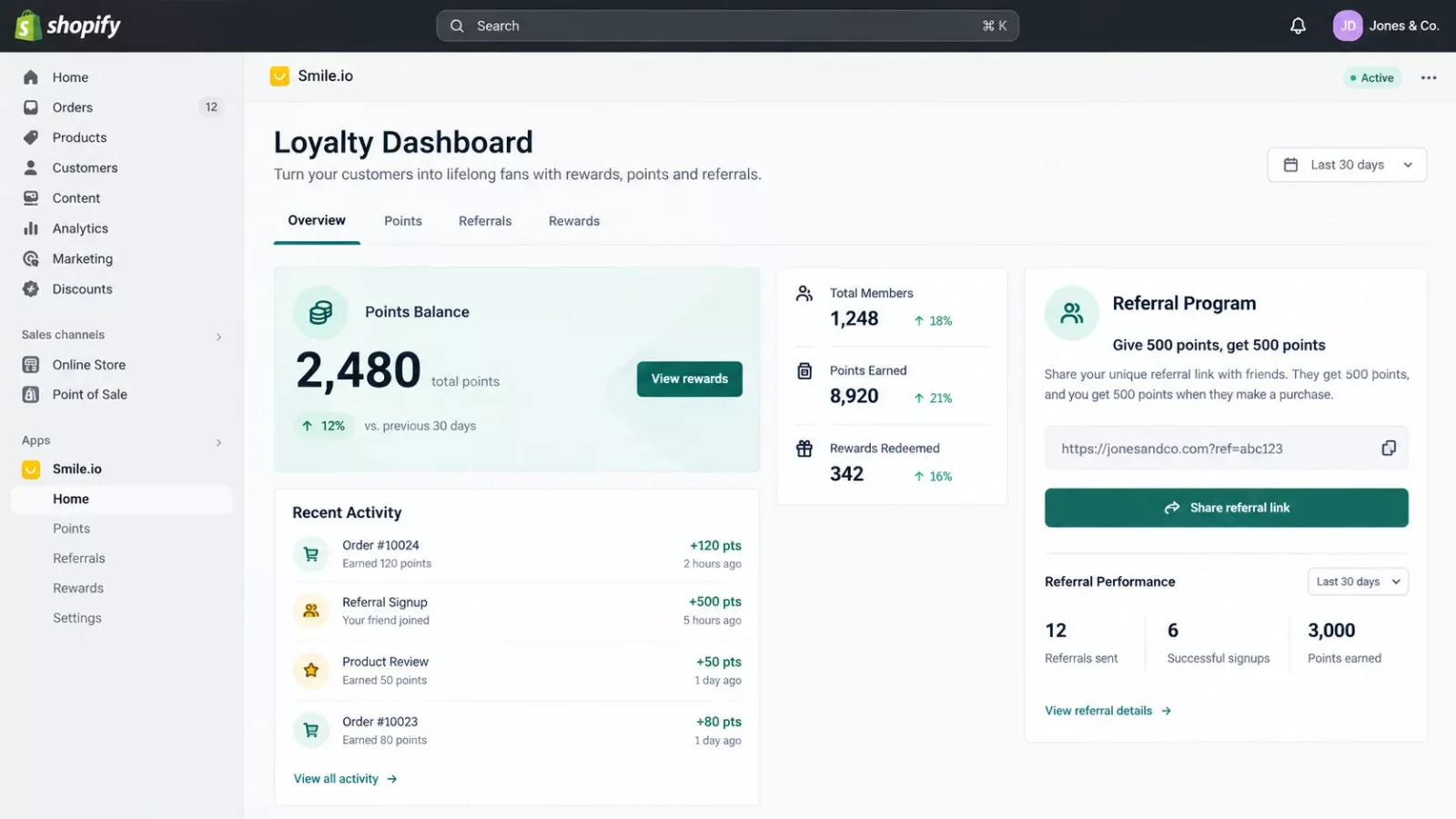
Smile.io is the most recognized loyalty app on Shopify, and its free plan is genuinely usable, not just a trial. It supports points and referral programs for up to 200 orders a month at no cost, which covers plenty of small businesses just starting out. It's also one of the few apps on this list available directly to Wix stores, not just Shopify, if you're running your shop there instead.
The catch shows up once you want that loyalty data to go anywhere else. Smile.io does have native integrations with Klaviyo and Mailchimp, so points balances and VIP status can sync into your email tool automatically. But those integrations only unlock on a paid Smile.io plan (Standard, around $79 a month), and they only work with Klaviyo or Mailchimp specifically. If you run your customer list through a different CRM, or a simple spreadsheet, Smile.io's free plan has no native way to get that data there at all. It's a strong pick if you're already committed to Klaviyo or Mailchimp and can budget for the upgrade; less so if you're not.
2. 99minds: More Native Integrations, But Automation Waits for a Paid Plan
99minds leans harder into integrations out of the box, listing connections to HubSpot, ActiveCampaign, and Salesforce alongside the usual email tools. On paper, that looks like it solves the CRM-sync problem better than Smile.io does, since it names more CRMs by default instead of just two email platforms.
In practice, the free plan tells a different story. It caps at 50 transactions a month and gives you exactly one integration slot, with no automation workflow included at all. You need the Basic plan, priced around $49 a month, just to unlock a single automation workflow between 99minds and whatever you've connected it to. For a small business testing whether a loyalty program is even worth running yet, that's a real cost before you've proven the concept works. Where 99minds earns its place on this list is segmentation: its own comparison content breaks out recommendations by business type (Shopify store, restaurant, omnichannel retailer) rather than treating every merchant the same way, which is a genuinely useful starting point once you're ready to commit to a plan.
3. Yotpo Loyalty: Built for Brands Already Using Yotpo Reviews
Yotpo Loyalty works best as an add-on if you're already running Yotpo for product reviews, since points, reviews, and (where still active) SMS notifications share one dashboard. Yotpo has been narrowing its focus, too: it sunset its Subscriptions product in 2025 and folded Email and SMS into a smaller role, putting Reviews and Loyalty front and center as its core offering going forward.
On its own, as a first loyalty app for a small business with no existing Yotpo footprint, it's a harder sell. Yotpo's own pricing page is genuinely unclear on where limits sit, and independent reviewers note this directly rather than guessing at numbers. What's consistent across sources: a free tier exists for very low order volume, and moving past it means budgeting for one of the higher-priced plans this platform is generally known for compared to the Shopify-native names on this list. If reviews are already part of your stack, it's worth a look, since the shared dashboard genuinely saves time. If not, it's an expensive way to get a first loyalty program running, and a Shopify-native alternative will likely serve you better and cheaper.
4. Rivo: The Budget-Friendly VIP-Tier Option
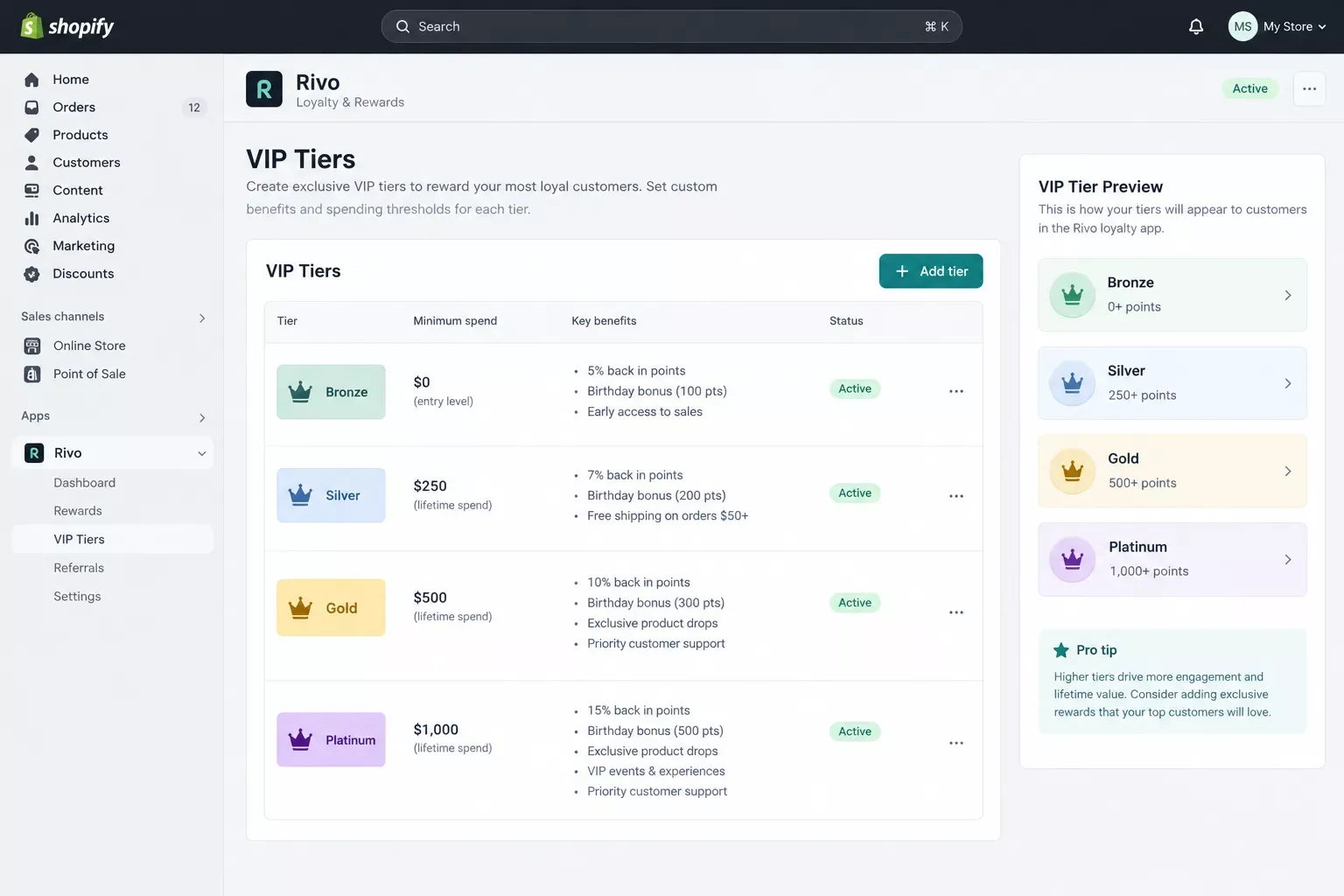
Rivo is the newer name on this list, and it's built around one clear pitch: VIP tiers and a wide integration library without Smile.io-level pricing to unlock them. Its paid Scale plan starts at $49 a month, consistently, across every source that covers it, and that's where VIP tiers, referrals, and dozens of integrations become available in one step, instead of being split across multiple price jumps the way some competitors structure things.
Rivo is also fully bootstrapped and ships weekly product updates, which shows in how often its feature set and integration list keep expanding. For a small business that wants a loyalty program with some real structure, not just a points counter, from day one, Rivo's entry pricing makes that more reachable than most of the names on this list. The trade-off worth knowing about upfront: there's a real pricing gap between its $49 entry tier and its next plan up, so budget accordingly if you expect meaningful order growth in year one.
5. BON Loyalty: The Most Generous Free Plan for International Stores
Per BON Loyalty's own Shopify App Store listing, its free plan covers up to 150 monthly orders and includes points, an anti-cheat referral program, automated point/referral emails, and discount-based rewards, genuinely more than most free tiers on this list. The Basic plan, around $29 a month, adds unlimited integrations, including Klaviyo, plus POS rewards for in-store customers. VIP tiers only unlock on the Growth plan.
Where BON stands out is language support. If you sell internationally, its multi-language display is a real differentiator most competitors here don't match, letting the same loyalty widget speak to customers in their own language without a separate setup for each storefront. It's also one of the higher-rated apps in this category on the Shopify App Store, with a large volume of reviews behind that rating, which is worth weighing if store reliability and support responsiveness matter to you as much as the feature list. For a small business selling to a genuinely international customer base on a tight budget, this is one of the stronger free-to-affordable starting points on this list.
6. LoyaltyLion: The Deepest Klaviyo Integration, If You Can Afford It
LoyaltyLion's free plan is genuinely usable up to roughly 400 monthly orders, but it's stripped down: no referral program, no VIP tiers, and, notably for this article's core problem, no email or SMS integrations at all on the free tier. Once you move to the paid Classic plan (around $199 a month), you get one of the most tightly-built Klaviyo integrations in this category, syncing loyalty events directly into email flows with genuine depth, not just a basic points-balance sync.
LoyaltyLion also supports more than just Shopify, including BigCommerce, Magento, WooCommerce, and Salesforce Commerce Cloud, which matters if you sell across more than one platform, and want one loyalty program running everywhere instead of juggling separate tools. For a small business just starting out on a single storefront, though, that's a real gap: the exact CRM/email-sync capability this article is about only shows up once you're already paying a premium price, well above most of the other names on this list.
7. Loopy Loyalty: The Only App Here With a Verified, Official Make.com Integration
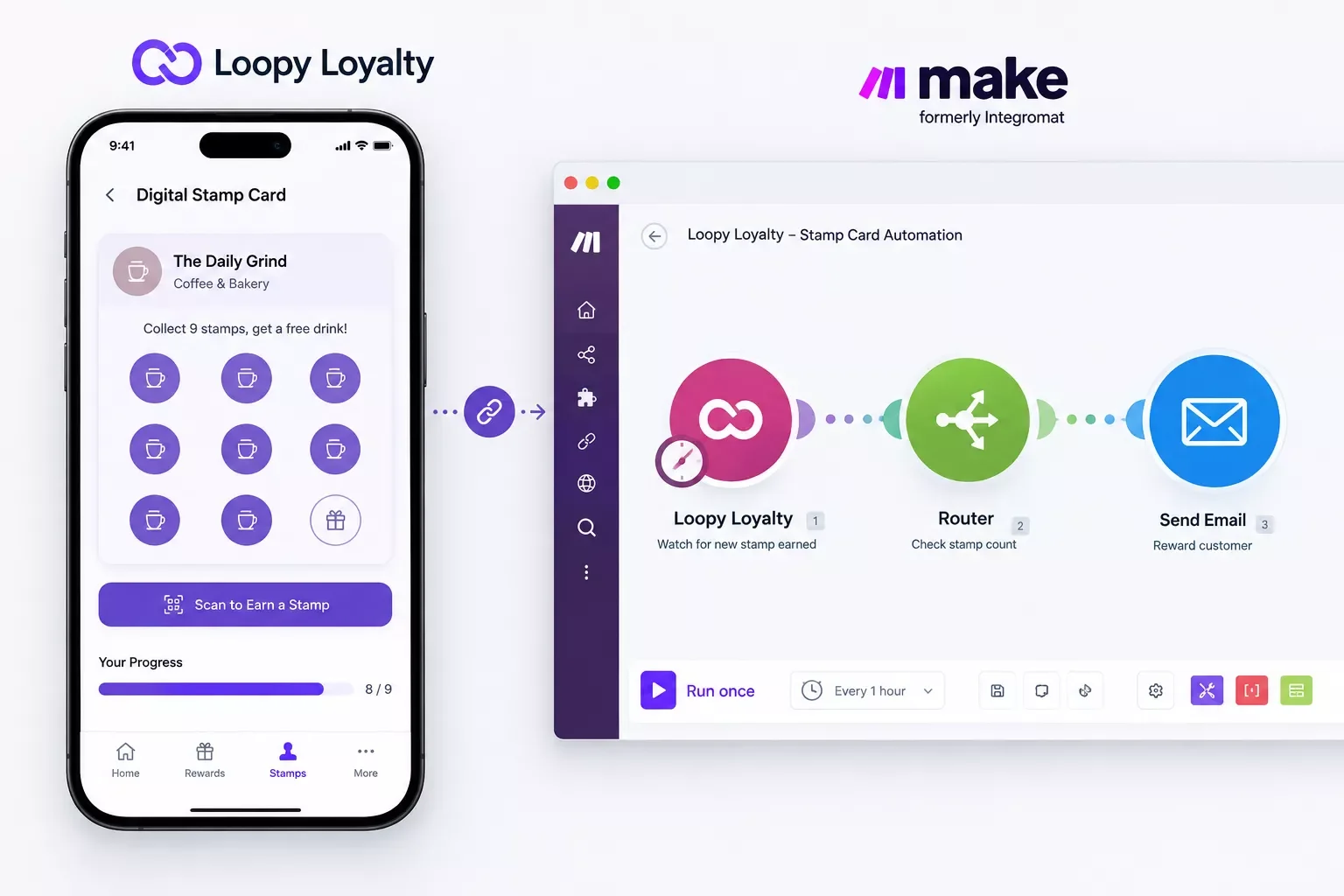
Loopy Loyalty takes a different approach entirely: no points system, just branded digital stamp cards that live in Apple Wallet and Google Wallet. There's no free plan (paid plans start around $25 a month), but it earns its spot on this list for one specific reason: it's the one app here with a genuine, Verified, Official Vendor integration listed directly on Make.com's own integrations page, maintained by Loopy Loyalty's own team (PassKit). That means real triggers like "customer enrolls in a loyalty program" and "reward is redeemed," ready to plug straight into a Make.com scenario, no workaround required.
It's a natural fit for cafes, salons, and other repeat-visit local businesses where a simple "buy 9, get 1 free" model makes more sense than a points economy. If your business runs on that kind of simple punch-card-style loyalty rather than points, this is the most direct path from a new sign-up to your CRM of anything on this list, and the built-in Make.com support means you're not building the connection yourself from scratch.
Pricing above was verified at the time of writing. Since pricing changes frequently, please confirm current rates and plan details directly on each provider's official website before making a decision.
Turning Any Loyalty App Into a CRM-Connected Loyalty App With Make.com
Most loyalty apps only sync to your CRM or email list once you're paying for a specific paid plan, and even then, usually to just one or two named tools like Klaviyo. A simple Make.com scenario closes that gap for any loyalty app, on any plan, connecting a new Shopify customer straight to whatever CRM or spreadsheet you're already using.
Here's what actually happens: Shopify's New Event module in Make.com is webhook-based, which means it fires the moment a new customer or order comes in, not on a delay. This matters, because Shopify also offers a "Watch Orders" module that checks on a set schedule instead, and a scheduled check can burn through operations even on runs where nothing new shows up. For this use case, the instant, webhook-based trigger is the right one, and it costs nothing extra to set up correctly.
From there, the scenario does two things: it writes the new customer's name and email into a Google Sheet (or whatever CRM you're already using, most have a Make.com connection), and it sends a welcome email with their first reward code. Setup takes connecting two accounts, Shopify and your CRM/email tool, both through a simple login screen, no API keys or developer steps required for the CRM/Sheets side. For anyone who's found one of the more thorough breakdowns of Make.com automation workflows on SmartSoloFlow, this is about as close to plug-and-play as loyalty automation gets.
Free plans work fine for the first few months, but the moment your CRM sync matters, check whether your chosen app's paid tier actually connects to the CRM or email tool you already use, not just Klaviyo or Mailchimp by name. If it doesn't, that's exactly where a five-minute Make.com scenario earns its keep. If you're weighing no-code app options beyond just loyalty, our full no-code app builder comparison guide covers the wider landscape. And once your welcome email is going out automatically, the same logic extends further: see how to set up email automation that triggers itself for more ways to automate your outreach beyond just the first message.
⚠ Watch Out For: Free-plan order caps are enforced automatically on most of these apps. Cross the limit mid-month and some apps pause new enrollments until you upgrade, others just start billing. Check your current monthly order count before picking a free tier to build on.
Ready to Skip the Manual Setup?
Comparing seven apps is the easy part. Actually wiring one of them into your CRM so new members do not just sit in a dashboard is where most small business owners run out of time, or patience for troubleshooting API connections on their own.
Here's a tip that costs nothing: before building anything custom, check your chosen app's own integration list first, some of the gaps above close on a specific paid tier without needing Make.com at all.
If setting this up yourself still isn't the best use of your week, this is exactly the kind of build I hand off, fully working, for small teams like yours.
People Also Ask
How much does a loyalty app cost for a small business?
Most loyalty apps offer a genuinely usable free plan for low order volumes, typically under 150-200 orders a month. Paid plans generally start in the $25-$50 range once you need VIP tiers or deeper integrations, with premium tiers climbing well past $199 a month at higher volumes.
Does a loyalty app need to integrate with an existing point-of-sale system?
Only if you sell in person as well as online. Several apps on this list, including BON Loyalty and Smile.io, support Shopify POS on their paid plans so in-store purchases earn points the same way online orders do. Purely online stores can skip this entirely.
How can a small business tell if its loyalty program is actually working?
Watch repeat purchase rate and average order value for enrolled members versus non-members over 60-90 days, not just sign-up count. A loyalty app that only reports enrollments, without those comparisons, makes it hard to know if the program is paying for itself.
Can I use a loyalty app without any coding experience?
Yes. Every app on this list installs directly from the Shopify App Store with no code involved. The Make.com automation described above is also no-code, built by connecting accounts through login screens rather than writing scripts.
Will a loyalty app work with the point-of-sale system I already use in-store?
If you're on Shopify POS specifically, several apps here support it natively on a paid plan. If you use a different POS system entirely, check that app's integration list before committing, POS support varies a lot between these tools.
What happens if I outgrow a loyalty app's free plan?
You will typically need to upgrade to keep enrolling new members once you pass the order cap. Export your existing member data first if you are considering switching apps entirely, most platforms support this from account settings.
Can a loyalty app connect to my CRM even if it does not have that as a built-in feature?
In most cases, yes, through a Make.com scenario that reads new sign-ups from the loyalty app or Shopify directly and writes them into your CRM. This works even on apps with no native CRM integration on any plan.
⚡ Pro Tip: Before trusting any automation with real customer data, use Make.com's "Run Once" test on a single dummy order first. It catches mapping mistakes, like a name landing in the email field, before they reach your actual CRM.
Picking a loyalty app for your small business does not have to mean settling for whatever your CRM gap forces on you. Start with the free plan that fits your order volume, and treat the Make.com side as a separate, solvable problem rather than a reason to pick a more expensive app than you actually need.
Ready to build automated systems for your business? At SmartSoloFlow, I help small business owners like you set up practical automations without the developer price tag.
Want This Set Up for Your Business?
If you'd rather have a working automation in place than spend a weekend building one yourself, reach out and let's talk about what you need.
Let's TalkFound this guide useful? Share it with a fellow freelancer who's still doing things manually. 🚀
Got a question or a workflow roadblock? Drop it in the comments below, happy to help.
Last Updated: September 29, 2026

// Comments