 SmartSoloFlow

Key Takeaway: If you just need one answer: CloudTalk wins for teams that want AI calling built into a real phone system, Retell AI wins on raw per-minute cost and latency for developers, and Synthflow wins if you want a no-code builder without touching an API. But the tool you pick matters less than what happens to the call data after, that's the part most comparisons skip.
The best AI voice agent for most small businesses in 2026 depends less on which platform sounds most human and more on what happens to the call after it ends. Tech enthusiasts and tool-comparison searchers evaluating an AI voice agent quickly hit the same wall: every review ranks tools on latency, voice quality, and native CRM sync, then stops there. This comparison covers six real platforms, CloudTalk, Synthflow, Retell AI, Vapi, Bland AI, and PolyAI, on pricing, setup complexity, and who each one actually fits. But it also answers the question competitors leave out: what do you do with call transcripts, lead scores, and structured data once native CRM sync isn't enough? That's where a Make.com automation layer turns a single voice agent into a system that updates five tools at once. Written in American English, verified against each vendor's current pricing and Make.com integration status as of writing.
Best AI Voice Agent in 2026: 6 Tools Compared
Picking an AI voice agent shouldn't take three weeks of demo calls. You already know you want one, you're just not sure which of the dozen names showing up in your searches actually deserves your budget. This guide compares six real platforms head-to-head and, more importantly, shows you what to do with the call data once you have it. For a broader look at how voice agents fit into the wider automation picture, see our AI agents comparison.
Best Overall: ⭐⭐⭐⭐☆ CloudTalk: 4/5, for teams that want AI calling and a full phone system in one place.
Best for Developers: Retell AI, with the lowest published per-minute floor and sub-700ms latency.
Best No-Code Option: Synthflow, with a visual builder and zero API required to launch.
Head-to-Head Comparison
| Feature | CloudTalk | Synthflow | Retell AI | Vapi | Bland AI | PolyAI |
|---|---|---|---|---|---|---|
| Setup style | No-code, built into phone system | No-code visual builder | Low-code builder + API | Developer/API-first | No-code + Pathways builder | Enterprise, managed setup |
| Starting price | From $99/mo for 200 min (published rate); some sources cite the AI Voice Agent as a custom-quote add-on, so confirm current pricing directly before budgeting | Pay-as-you-go, roughly $0.15-$0.24/min per Synthflow's own FAQ (legacy flat tiers have been retired) | From $0.07/min base (voice infrastructure only; full stack typically lands $0.13-$0.31/min) | From $0.05/min hosting (model and telephony costs pass through separately) | Flat rate near $0.09/min, all-inclusive per vendor | Custom enterprise contracts, no published self-serve pricing found |
| Native Make.com app | ✅ Official (Make.com's own integrations directory) | ✅ Native, per vendor | ✅ Official (make.com integrations) | ✅ Native, per vendor | ✅ Verified app (Make-partner built, not vendor-maintained) | ⚠️ No official app found, webhook/API only |
| Best for | SMBs wanting AI + real phone system together | Non-technical teams, fast no-code launch | Developers wanting low latency + control | Engineering teams building custom stacks | High-volume outbound campaigns | Large enterprise contact centers |
Pricing above was verified at the time of writing. Since pricing changes frequently, and several vendors quote figures that conflict across sources (CloudTalk and Synthflow especially), please confirm current rates directly on each provider's official website before making a decision.
Pros & Cons
CloudTalk pairs AI calling with a full VoIP phone system, so you're not running two separate tools for reps who also take manual calls. That convenience comes with less pricing transparency on the AI add-on itself.
Pros
- AI voice agent and phone system live in one platform, no separate tool to manage
- Deep native CRM integrations (Salesforce, HubSpot, Zendesk) included from the entry AI tier
- Official Make.com app with real-time call, contact, and activity triggers
- 24/7 autonomous handling with human handoff built in
Cons
- AI Voice Agent pricing is inconsistently published, some pages quote $99/month, others point to a custom sales quote
- Minimum license requirements kick in on higher tiers, not ideal for a true solo operator
- Geared toward teams already comfortable with a dialer-style interface
Who Is This For?
This comparison is built for solopreneurs and small business owners who already know they want an AI voice agent and just need to pick one fast, not for enterprise buyers evaluating a 2,500-seat contact center rollout. If you're fielding under a few thousand call minutes a month and want something live within a day, CloudTalk or Synthflow fit better than a developer platform like Vapi. If you have even light technical comfort (or a freelancer who does), Retell AI's low published rate and fast latency make it worth the extra setup step. Bland AI suits outbound-heavy use cases, think appointment reminders or lead qualification campaigns, where flat per-minute pricing is easier to forecast than CloudTalk's tiered bundles. If you're also exploring how routed call data can feed customer-facing automation, our piece on an AI customer service bot covers a closely related setup. PolyAI is realistically out of reach for this audience; its custom enterprise contracts start well above what a solo operator or small team would budget for phone automation.
Deep Dive Into Features
CloudTalk. Built on top of an existing VoIP platform (in market since 2015, serving 30,000+ users), CloudTalk's AI Voice Agent answers routine calls, routes complex ones to a human with context attached, and syncs the outcome back to your CRM automatically. The catch, confirmed across multiple pricing breakdowns during research for this article, is that the AI add-on's real cost is genuinely unclear: CloudTalk's own blog cites $99/month for 200 minutes, while a third-party pricing audit found a custom-quote-only structure with no public rate for the AI layer specifically. If pricing certainty matters to you, request a live quote before committing.
Synthflow. The no-code builder here is the real selling point: drag-and-drop agent design, no API keys, no Twilio configuration required. Synthflow also confirms native integrations with Make, Zapier, and GoHighLevel directly in its own feature list, more than most competitors on this list offer out of the box. Pricing moved to a pay-as-you-go, per-minute model in 2026 (roughly $0.15 to $0.24/min combining voice engine, LLM, and telephony costs); older flat-tier pricing you may still see quoted on review sites has been discontinued.
Retell AI. The lowest published entry rate on this list ($0.07/min for voice infrastructure alone), Retell AI adds LLM and telephony costs on top, typically landing between $0.13 and $0.31/min all-in for a production setup. Independent benchmarking puts its latency around 600ms, among the fastest of the platforms compared here. For a look at other comparison tools that verify their AI transcript generator claims the same way, see our related breakdown.
Routing Voice Agent Call Data Beyond Native CRM Sync
Native CRM sync only tells you what happened on one call, inside one CRM. The bigger question every comparison on this topic skips: what if you want that transcript to also hit Slack, update a spreadsheet, tag the lead by score, and trigger a follow-up email, all from one call, without touching four separate integration settings?
That's where a Make.com scenario sits between the voice agent and everything downstream. Instead of relying on whatever native sync a vendor ships, the voice agent fires one webhook when a call ends. Make.com receives that payload, and from there you can branch it anywhere: a high-intent lead goes to your free CRM for startups setup and pings a Slack channel, a routine call just logs to a spreadsheet, a flagged complaint routes straight to a support ticket. This same branching logic is what powers a chat bot builder that routes leads, just applied to voice instead of chat. None of the six tools compared here natively do this kind of multi-destination branching on their own, it's exactly the layer Make.com adds.
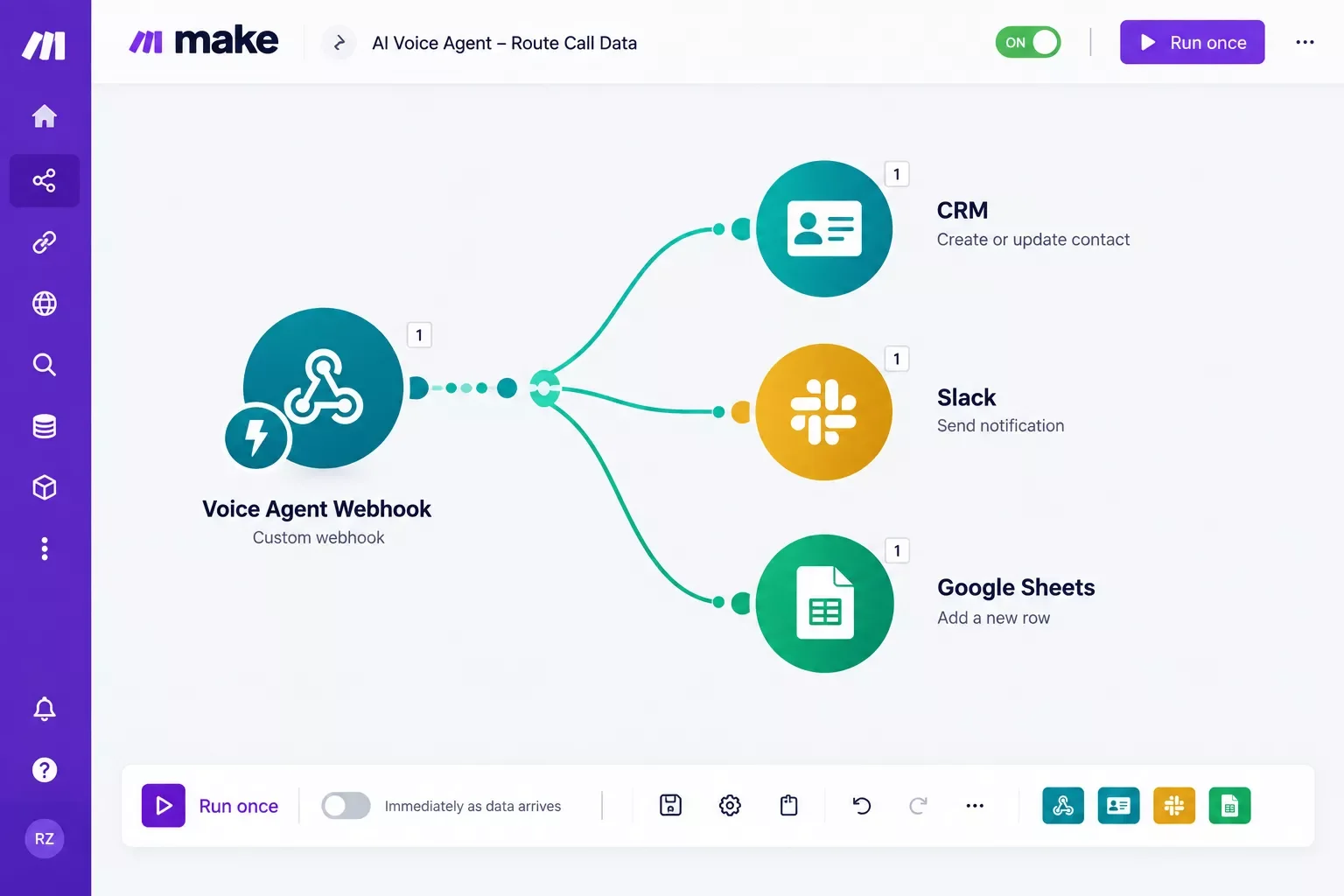
This setup takes roughly 30 minutes to wire up on any of the six tools above, since all six support either a native Make.com app or a generic webhook trigger. The practical payoff: instead of manually checking a CRM, a Slack channel, and a spreadsheet separately to know what happened on a call, everything updates itself the moment the call ends.
Pricing & Hidden Costs
Per-minute platforms (Retell AI, Vapi, Bland AI) look cheaper on the sticker but scale differently than flat-tier platforms (CloudTalk, Synthflow's legacy plans). At 2,000 minutes/month, a rough cost comparison: Retell AI lands around $260-$620 all-in (using its confirmed $0.13-$0.31/min production range), Vapi similarly in the $200-$600 range depending on model choice, and Bland AI's flat $0.09/min comes out to a predictable $180. Synthflow's current pay-as-you-go rate puts the same volume at roughly $300-$480. CloudTalk's published $99/month covers only 200 minutes, so 2,000 minutes would require either a higher published tier or a custom quote, exact figure unconfirmed at the time of writing. These AI SEO tools that actually connect to Make.com went through the same verification process for their own pricing claims.
Figures above were calculated using each vendor's own published or confirmed per-minute rates at the time of writing. Actual costs vary by call length, model choice, and telephony provider, confirm current rates directly with each vendor before budgeting.
Final Verdict & Use-Case Scenarios
Ideal for Solopreneurs & Small Teams: pick CloudTalk if you want AI calling and your actual phone system running through one login, or Synthflow if you'd rather build the agent yourself without touching an API.
Ideal for Developer-Led Setups: pick Retell AI for the lowest published rate and fastest latency, or Vapi if you want full control over which LLM and voice provider power the agent.
Ideal for High-Volume Outbound: pick Bland AI for predictable flat per-minute pricing across large campaign volumes.
Not a fit for this audience: PolyAI's enterprise-only contracts and lack of a published self-serve tier make it impractical for a solopreneur or small team budget.
Conclusion & Rating
Based on documented features, confirmed pricing (where publicly available), and researched integration depth as of this writing:
⭐⭐⭐⭐☆ CloudTalk: 4/5, best overall for SMBs wanting AI calling built into a real phone system.
⭐⭐⭐⭐☆ Retell AI: 4/5, best for developers who want low latency and transparent per-component pricing.
⭐⭐⭐⭐☆ Synthflow: 4/5, best no-code builder, though pricing shifted to a less predictable per-minute model in 2026.
⚠ Watch Out For: Several vendors on this list (CloudTalk especially) publish inconsistent pricing across their own blog, third-party audits, and sales pages. Always request a live quote before budgeting, don't rely on the first number you see in a search result.
⚡ Pro Tip: Before picking a platform, confirm it has either an official Make.com app or a documented webhook trigger, that's what lets you route call data anywhere beyond native CRM sync without waiting on the vendor to build a new integration.
Master Stroke — Integration With Make.com
Every tool compared here can hand off a finished call, but none of them decide what happens next across your whole stack. That's the layer Make.com adds: one voice agent event triggering CRM updates, Slack alerts, spreadsheet logging, and follow-up emails simultaneously, instead of you manually checking four separate places. CloudTalk, Synthflow, Retell AI, and Vapi all connect via an official, vendor-maintained Make.com app. Bland AI connects through a Make-verified app built and maintained by a Make partner rather than by Bland AI itself, still a reliable, ready-made option, just not first-party. PolyAI would need a custom webhook/API setup since no app currently exists in Make's directory for it. If you'd rather not wire this scenario together yourself, one of more thorough breakdowns of Make.com automation workflows you'll find is exactly what SmartSoloFlow builds, done-for-you, for small teams like yours.
Want This Routing Set Up For You?
If you'd rather get your time back than spend a weekend wiring webhooks yourself, this is exactly the kind of build I set up so solopreneurs and small teams don't have to.
Let's TalkPeople Also Ask
What is the best AI voice agent for a small business in 2026?
For most small businesses, CloudTalk is the strongest overall pick because it bundles AI calling with a full phone system and CRM sync. If you want a no-code builder instead, Synthflow is the easiest to launch without technical help.
Can call transcripts from an AI voice agent be automatically routed into a CRM or spreadsheet?
Yes. Most platforms offer native CRM sync out of the box, but for routing the same data to multiple destinations (CRM, Slack, a spreadsheet) at once, a Make.com scenario triggered by the agent's webhook is the more flexible option.
What's the difference between an AI voice receptionist and a developer voice-agent platform?
A receptionist-style tool like CloudTalk or Synthflow is built for non-technical setup and answers calls out of the box. A developer platform like Vapi gives you full control over the model, voice, and logic, but requires API and telephony configuration to launch.
Do AI voice agents require a paid Make.com plan to connect?
Make.com's free tier supports a limited number of scenario operations per month, which is enough for testing a voice-agent-to-CRM automation. Higher call volumes or multi-step branching (CRM plus Slack plus Sheets) typically require a paid Make.com plan to avoid hitting the operations cap.
How much does an AI voice agent cost per month for a solo operator?
At low call volumes (under 500 minutes/month), expect roughly $75-$180/month on a per-minute platform like Bland AI or Synthflow, or CloudTalk's published $99/month entry tier for 200 minutes, whichever fits your actual call volume best.
Which AI voice agent has the fastest response time?
Retell AI, with independently benchmarked latency around 600ms, among the fastest of the platforms compared in this guide.
Is there a free AI voice agent option?
None of the six platforms here offer a permanent free tier, though most (Synthflow, Vapi, Retell AI) offer a free trial or pay-as-you-go start with no monthly commitment.
Can I switch AI voice agent platforms later without losing my Make.com automation?
Yes, if your Make.com scenario is built around a generic webhook trigger rather than a vendor-specific module, swapping the voice agent behind it usually just means updating the webhook URL.
Do I need coding experience to set up any of these tools?
No, for CloudTalk, Synthflow, and Bland AI's no-code builder. Vapi and Retell AI are more developer-oriented, though both offer visual builders alongside their APIs.
⚡ Pro Tip: Don't pick based on the sticker price alone. Run the actual math at your expected call volume, a platform that looks cheaper at 100 minutes can flip completely at 2,000.
One of the more thorough breakdowns of Make.com automation workflows you'll find starts exactly where this comparison ends: picking the tool is the easy part, wiring the data to actually move where you need it is where most setups fall short. SmartSoloFlow builds exactly that kind of automation for solopreneurs and small teams who'd rather not spend a weekend in Make.com's scenario builder themselves. Reach out via our contact page if you want this routing built for your specific stack. For the broader picture of what's already live, browse our full AI tool reviews hub.
Found this guide useful? Share it with a fellow freelancer who's still doing things manually. 🚀
Got a question or a workflow roadblock? Drop it in the comments below, happy to help.
Last Updated: September 15, 2026

// Comments